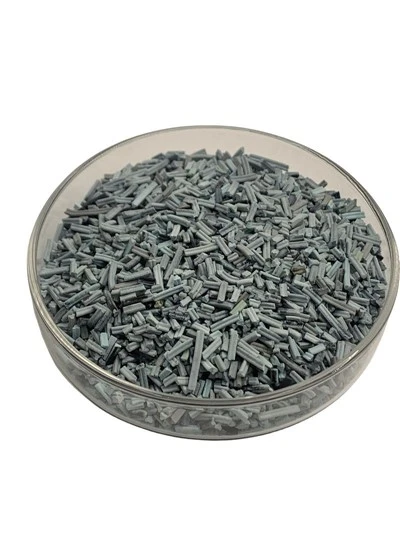
VGO Pretreatment Catalyst is engineered for fixed-bed hydroprocessing units to achieve deep hydrodesulfurization (HDS), hydrodenitrogenation (HDN), and hydrodemetallization (HDM) of vacuum gas oil (VGO) streams. Designed as the primary stage or protective guard system before downstream fluid catalytic cracking (FCC) or hydrocracking, the catalyst optimizes feedstock quality by removing refractory sulfur and nitrogen compounds, reducing heavy metal contaminants (Ni, V, Fe), and controlling aromatics.
The catalytic formulation utilizes optimized transition-metal active phases supported on high-purity alumina structures with tailored pore network architectures, balancing mechanical integrity, diffusional efficiency, and long-term activity stability under severe reactor operating regimes.
Catalyst Selection Parameters
|
Selection Parameter |
Engineering Consideration |
|
Feedstock Source |
Straight-run VGO, coker VGO, visbroken gas oil, or deasphalted oil (DAO) blends. |
|
Sulfur and Nitrogen Levels |
Establishes the required kinetic activity for HDS and HDN reactions. |
|
Metals Content (Ni + V) |
Determines pore volume requirements and the necessity of upstream guard layers. |
|
Reactor Pressure & Temperature |
Governs reaction kinetics, hydrogen partial pressure, and thermodynamic equilibria. |
|
Liquid Hourly Space Velocity (LHSV) |
Dictates required reactor volume and catalyst loading density. |
|
H2/Oil Ratio |
Ensures adequate hydrogen availability for deep hydrotreating and coke suppression. |
|
Cycle Length Target |
Balances initial activity against deactivation rates to achieve run-length objectives. |
Target Applications and Process Objectives
FCC Feed Pretreatment
Objective: Process straight-run VGO, coker VGO, or heavy blends to reduce sulfur and nitrogen compounds while suppressing metals deposition.
Operational Value: Stabilizes downstream FCC catalyst activity, minimizes sulfur oxides (SOx) and nitrogen oxides (NOx) emissions, and enhances liquid yield distribution.
Hydrocracker Pretreatment
Objective: Provide extensive purification to protect precious noble-metal or amorphous silica-alumina cracking catalysts.
Operational Value: Achieves ultra-low nitrogen slip (sub-ppm levels) and deep aromatics saturation under elevated partial pressures of hydrogen.
Heavy VGO and Residue Blends Processing
Objective: Handle contaminated or heavier feeds with elevated Conradson Carbon Residue (CCR) and particulate matter.
Operational Value: Utilizes enhanced macropore volumes to prevent premature pore-mouth plugging and high pressure-drop accumulation.
Chemical Systems and Structural Properties
Active Phase Systems: Customized CoMo or NiMo formulations tailored for specific HDS/HDN activity balances. CoMo systems are optimized for high-efficiency HDS, whereas NiMo systems provide superior hydrogenation and HDN performance under rigorous operating conditions.
Support Morphology: Alumina-based carriers engineered with controlled specific surface areas, pore volumes, and bimodal pore size distributions to facilitate heavy molecule diffusion.
Mechanical Strength: High side-crushing strength and low attrition losses prevent bed compaction, dusting, and localized flow channeling during long commercial cycles.
Manufacturing and Quality Assurance
Impregnation Control: Automated solution uptake monitoring ensures uniform active metal distribution across the support matrix.
Thermal Processing: Controlled calcination and drying profiles prevent structural shrinkage and preserve active phase oxidation states.
Analytical Verification: Comprehensive laboratory testing utilizing advanced analytical instrumentation:
ICP-OES / XRF: Precise elemental composition and active metal loading verification.
BET Analysis: Surface area, pore volume, and pore size distribution confirmation.
Laser Diffraction: Particle size consistency and fines reduction.
Mechanical Testing: Crush strength and attrition resistance verification.
Storage, Handling, and Activation Guidelines
To maintain catalyst activity and mechanical integrity prior to and during reactor loading, specific protocols are recommended:
Moisture Protection: Catalysts must be stored in dry, sealed containers or super sacks lined with moisture-barrier materials to prevent hydration of alumina supports.
Dust Minimization: Uniform particle sizing and high attrition resistance minimize fine generation during dense or sock loading into commercial reactors.
Pre-Sulfiding Requirements: Oxide-form catalysts require precise in-situ or ex-situ sulfiding (using dimethyl disulfide or equivalent spiking agents) to convert active metal oxides into active sulfide phases prior to heavy feed introduction.
Frequently Asked Questions
Q: How does catalyst pore structure affect heavy VGO processing?
A: Heavy VGO fractions contain large, complex hydrocarbon molecules that can cause diffusional limitations and plug pore entrances. A catalyst with an optimized bimodal pore size distribution provides wide transport pores for heavy molecules to access internal active sites, preventing rapid pore mouth plugging and extending cycle length.
Q: What is the difference between CoMo and NiMo formulations for VGO?
A: CoMo-based catalysts are generally selected when the primary objective is deep hydrodesulfurization (HDS) at moderate operating conditions. NiMo-based catalysts offer higher hydrogenation activity, making them superior for deep hydrodenitrogenation (HDN) and aromatic saturation, particularly in feeds directed to downstream hydrocrackers.
Q: Why is graded catalyst loading necessary in VGO hydroprocessing?
A: Graded loading prevents premature catalyst deactivation caused by metals (nickel and vanadium) deposition and particulate accumulation at the top of the reactor. By placing high-capacity, high-void-fraction guard materials upstream, the system mitigates pressure-drop buildup and protects the main high-activity beds below.
Hot Tags: vgo pretreatment catalyst, China vgo pretreatment catalyst manufacturers, suppliers, factory, advanced hydrorefining catalyst, hydrorefining catalyst for better fuel storage, hydrorefining catalyst for factory use, hydrorefining catalyst for glass industry, hydrorefining catalyst for improvement use, hydrorefining of crude oil catalyst