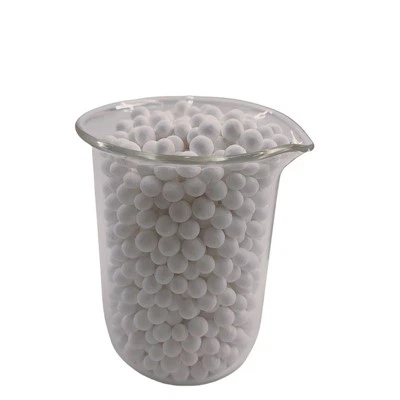
This industrial iron-based Claus catalyst is engineered for sulfur recovery units (SRUs) operating under challenging conditions where catalyst protection, oxygen tolerance, and stable sulfur conversion are critical operational requirements.
Utilizing an activated alumina carrier impregnated with Fe2O3 as the primary active material, this formulation combines standard Claus catalytic activity with targeted deoxygenation protection. It functions simultaneously as an active conversion catalyst and a sacrificial guard layer to minimize downstream catalyst sulfation caused by trace oxygen ingress.
Technical Specifications
|
Parameter |
Specification |
|
Primary Active Material |
Fe2O3 |
|
Support / Carrier |
Activated Alumina (Al2O3) |
|
Appearance |
Brown Sphere or Strip |
|
Specific Surface Area |
>= 260 m2/g |
|
Bulk Density |
0.70 - 0.90 g/mL |
|
Crushing Strength |
>= 130 N |
|
Wear Rate |
<= 0.3% |
|
Particle Size |
Customizable to reactor design requirements |
|
Primary Functions |
Claus reaction + Deoxygenation protection |
|
Loading Configuration |
Standalone or layered loading |
Target Industrial Applications
Petroleum refineries (SRU units)
Natural gas processing and sweetening plants
Gas purification and coal chemical facilities
Acid gas treatment and sulfur recovery plants
Operational Challenges Addressed
Trace oxygen entering a Claus unit via air leakage, feed gas fluctuations, or acid gas variability accelerates sulfate formation on active catalyst surfaces. Sulfate deposition blocks internal pores, reduces active surface area, and induces premature catalyst deactivation.
This product is specifically formulated to mitigate operational risks associated with:
- Fluctuating acid gas feed flows and variable H2S concentrations
- Excess SO2 or trace O2 in the reaction feed
- Air-to-acid-gas ratio instability
- Long operating cycles requiring high resistance to thermal and chemical degradation
By integrating deoxygenation protection directly into the catalyst bed, the material neutralizes trace oxygen before it damages downstream conventional activated alumina or titanium dioxide (TiO2) catalyst beds.
Dual-Function Bed Performance
Claus Catalytic Activity: Accelerates the reaction between hydrogen sulfide (H2S) and sulfur dioxide (SO2) to yield elemental sulfur in the catalytic reaction stages.
Deoxygenation Protection: Consumes or mitigates trace oxygen within the process gas stream, halting sulfate accumulation on downstream catalyst inventories.
Upstream Bed Guarding: Positioned as a top-layer guard section to absorb initial thermal shocks, particulate accumulation, and chemical poisons.
Recommended Catalyst Loading Configurations
Standalone Loading: Deployed independently throughout the entire reactor when process conditions require combined catalytic conversion and continuous oxygen protection.
Layered Loading: Installed as an upper protective layer (typically occupying 1/2 or 1/3 of the total reactor filling volume) directly above conventional activated alumina or TiO2-based catalysts. The lower bed handles bulk sulfur conversion.
Manufacturing, Quality Control & Customization
Consistent particle properties are vital to prevent localized channeling, bed overheating, and excessive pressure drops. Production lots undergo rigorous physical and chemical verification, including:
- Chemical composition assay (Fe2O3 content verification)
- Specific surface area testing via BET method
- Bulk density and particle dimension measurement
- Mechanical crushing strength and attrition wear resistance testing
Customization Capabilities
For plant retrofits or specific reactor geometry requirements, customized parameters are available for:
- Active ingredient concentration
- Pellet shape and particle dimensions
- Bulk density adjustments
Handling, Loading & Storage Guidelines
On-Site Handling: Designed with high mechanical strength (>= 130 N) and low attrition wear (<= 0.3%) to minimize dust generation during dense loading operations.
Storage Recommendations: Stored in dry, sealed conditions away from moisture and chemical contaminants to preserve specific surface area and active phase integrity prior to installation.
FAQ
Q: What is the primary difference between a conventional activated alumina Claus catalyst and an iron-based guard catalyst?
A: A standard activated alumina catalyst is primarily designed to provide active sites for the main Claus reaction between H2S and SO2. An iron-based guard catalyst incorporates Fe2O3 to provide both Claus activity and active deoxygenation protection, capturing trace oxygen before it causes sulfate poisoning and pore blockage on downstream catalyst beds.
Q: Can this iron-based guard catalyst be regenerated once sulfur or sulfate accumulation reduces its activity?
A: Regeneration feasibility depends on the nature of the deactivation. While physical accumulation and minor sulfate deposits can sometimes be managed via standard high-temperature thermal regeneration or inert gas sweep procedures specified by plant operating guidelines, severe chemical poisoning or structural sintering may require partial or full catalyst replacement. Plant operators should consult engineering parameters before initiating thermal dry-out or regeneration cycles.
Q: What packaging options are available for international maritime and land transport?
A: To prevent moisture absorption and mechanical attrition during transit, the catalyst is typically supplied in moisture-proof woven bags lined with heavy-duty plastic, steel drums, or flexible intermediate bulk containers (FIBC / super sacks). Palletization and custom export packaging can be aligned with specific site offloading equipment and storage requirements.
Hot Tags: iron-based claus guard catalyst, China iron-based claus guard catalyst manufacturers, suppliers, factory