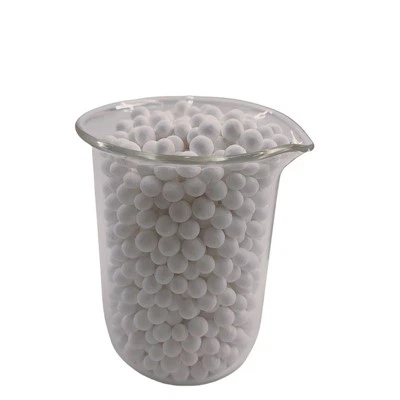
Product Introduction
A918 sulfur recovery activated alumina catalyst is a synthetic high-performance active alumina catalyst engineered with superior anti-sulfation poisoning resistance, outstanding organic sulfur hydrolysis efficiency and exceptional thermal stability.
Verified by full-scale industrial field trials, this catalyst delivers remarkable high catalytic activity and robust crushing strength, supporting continuous stable operation for 3 to 5 years.
Under identical or comparable process parameters, replacing bauxite catalyst with A918 lifts overall sulfur recovery rate from 80–85% up to 94–96%. It achieves complete 100% COS hydrolysis and cuts residual sulfur content in tail gas to less than 1%.
Boasting a specific surface area of 320 m²/g, A918 activated alumina catalyst meets world-class advanced standards across all technical performance indicators.
Product Parameters
Main technical indexes of A918 activated alumina catalyst
|
Industry-specific attributes |
|
|
Other attributes |
|
|
Place of Origin |
China |
|
Classification |
Catalyst |
|
Other Name |
Claus Catalyst |
|
Application |
Sulfur Recovery for Claus Process |
|
Brand Name |
XUNDA |
|
Model Number |
A918 Activated Alumina Catalyst |
|
Main technical indexes |
|
|
Main Raw Materials |
Al2O3 |
|
Appearance |
White sphere |
|
Al2O3,% |
More than 93 |
|
Size, mm |
φ4-6 |
|
Specific Surface Area, m2/g |
≥300 |
|
Bulk Density, Kg/L |
0.6-0.8 |
|
Average Crushing Strength, N/grain |
≥130 |
|
Abrasion Ratio, %(m/m) |
≤1 |
|
Pore Volume, ml/g |
≥0.4 |
|
Static Water Absorption |
50~70% |
|
Supply Ability |
|
|
Manufacturer |
Yes |
|
Certification |
ISO9001:2015 |
|
Supply Ability |
9500 Tons/Year |
|
Packaging and delivery |
|
|
Packaging Details |
Jumbo bag or steel drum package or cardboard bucket |
|
Port |
Shanghai, Ningbo, Shenzhen, Qingdao |
|
Selling Units |
Single item |
|
MOQ |
1ton |
Main technical indexes of A918 Activated Alumina Catalyst
|
Lead Time |
||
|
Quantity (kilograms) |
1-1000 |
>1000 |
|
Lead time (days) |
15 |
To be negotiated |
Application
The Claus process is the mainstream technology in sulfur recovery industry, converting hydrogen sulfide into elemental sulfur and water. Sour natural gas contains high levels of hydrogen sulfide. If burned directly as fuel, sulfide pollutants will escape, causing air pollution and severe environmental damage. Maximizing sulfur recovery from sour gas has become an essential global industrial demand.
Al₂O₃ is the most commonly adopted catalyst for Claus process. It boasts abundant surface active sites that adsorb H₂S and SO₂, driving their reaction to produce elemental sulfur.
Acid gas streams contain various sulfur compounds such as H₂S, COS and CS₂. Even if these organosulfur substances are not present in raw feed, burning H₂S with CO₂ or hydrocarbons will generate COS and CS₂ byproducts. Full conversion of these components is vital to secure high sulfur recovery rate. Their decomposition proceeds far more slowly than the H₂S-SO₂ Claus reaction, hence a high-activity catalyst is required. Sulfation poisoning is another critical issue, which reduces specific surface area and leads to rapid catalyst deactivation.
Our high-performance sulfur recovery activated alumina catalyst is perfectly suited for Claus units in natural gas plants, oil refineries, coking plants and tail gas treatment facilities.
Application


Our Factory

Factory Gate View

Fully automatic integrated equipment


Modern production line
FAQ
Q: What is the core role of the A918 sulfur recovery catalyst in the Claus process?
A: It mainly catalyzes the conversion of sulfides in acid gas into elemental sulfur, serving as a widely used basic catalyst in sulfur recovery units.
Q: What are the key highlights of the comprehensive performance of the A918 sulfur recovery catalyst?
A: It features stable catalytic activity and good mechanical strength with low breakage rate, enabling long-term continuous operation in industrial units.
Q: For which reaction stages are the A918 sulfur recovery catalyst suitable?
A: It has strong versatility, applicable to all stages of Claus reactors and can be combined with other types of catalysts.
Q: What auxiliary effects does the alumina carrier bring to sulfur recovery reactions?
A: The high-quality carrier structure provides sufficient reaction contact area to make the catalytic reaction more sufficient and stable.
Q: How to maintain the catalyst to extend its service life during daily operation?
A: Purify the feed gas in advance to reduce impurities entering the reactor and maintain stable working conditions to slow down performance degradation.
Product production process

Hot Tags: Activated Alumina Catalyst, China Activated Alumina Catalyst manufacturers, suppliers, factory, sulfur recovery handling, sulfur recovery industry enhancement, sulfur recovery environmental protection improvement, sulfur recovery environmental protection enhancement, sulfur recovery industry improvement, sulfur recovery maintenance