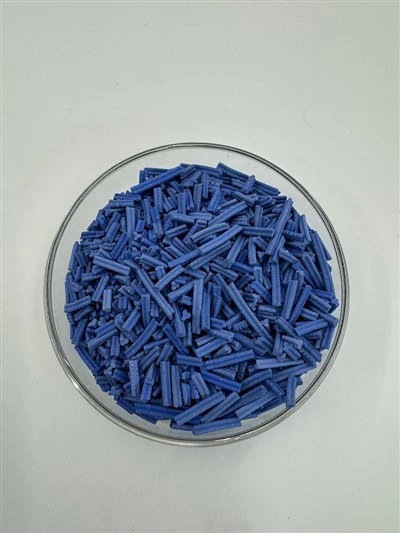
Our High Activity HDS Catalyst is a heterogeneous supported hydrogenation catalyst engineered for hydrodesulfurization (HDS) and hydrorefining operations in petroleum refining and petrochemical processing.
The catalyst utilizes a modified alumina (Al₂O₃) carrier with molybdenum trioxide (MoO₃) and cobalt oxide (CoO) as active metal components. This formulation is designed for industrial hydroprocessing units where deep organosulfur removal, nitrogen reduction, feedstock stabilization, and extended reactor cycle lengths are mandatory.
The product is supplied for continuous industrial operation, with formulation, geometric shape, and physical dimensions tailored to match specific unit designs and feedstock characteristics.
Technical Specifications
|
Technical Parameter |
Specification Standard |
|
Product Classification |
High Activity HDS Catalyst |
|
Catalyst Type |
Co-Mo supported heterogeneous hydrogenation catalyst |
|
Active Metal Components |
MoO₃ and CoO |
|
Carrier / Support |
Modified Al₂O₃ |
|
Primary Application |
Hydrodesulfurization / Hydrorefining / Pretreatment |
|
Target Feedstock |
Sulfur-containing petroleum fractions and hydrocarbon streams |
|
Physical Form |
Extrudates (cylindrical or shaped pellets) |
|
Customization Scope |
Metal loading, pore distribution, pellet geometry, mechanical strength |
Core Application & Process Scope
This catalyst is deployed in industrial hydroprocessing environments where sulfur and nitrogen compounds must be converted under hydrogen-rich conditions prior to downstream catalytic processing or final product blending.
Typical application areas include:
Hydrodesulfurization Of Petroleum Fractions
Processing straight-run and cracked naphtha, diesel, kerosene, and gas oil.
01
Hydrorefining Of Sulfur-containing Feedstocks
Meeting strict environmental sulfur and nitrogen thresholds.
02
Refinery Hydroprocessing Units
Maintaining stable catalyst activity while controlling reactor bed pressure drop.
03
Pretreatment Units
Protecting downstream noble-metal reforming or hydrocracking catalysts from sulfur and nitrogen poisoning.
04
Petrochemical Feedstock Purification
Treating cracking feeds and aromatic streams.
05
Operating Window & Process Requirements
HDS catalyst performance is directly tied to the operating window of the individual unit. The following parameters are evaluated during technical assessment:
Feedstock Characteristics: Boiling range, density, initial sulfur content (ppm or wt%), nitrogen content, and aromatics/contaminant levels.
Operating Conditions: Reactor operating temperature, total pressure, hydrogen partial pressure, Liquid Hourly Space Velocity (LHSV), and hydrogen-to-oil ratio.
Performance Targets: Required product sulfur specification, expected cycle length, and target run duration.
Unit Geometry: Reactor dimensions, catalyst bed volume, and existing loading configuration.
For catalyst replacement projects, historical operating data from the current unit are utilized to verify whether standard Co-Mo formulations or customized loading profiles are required.
Reactor Loading & Activation Guidelines
To achieve maximum commercial performance, industrial deployment requires adherence to established handling and start-up procedures:
Loading Methodology: Dense loading or conventional sock loading techniques are recommended to prevent segregation and minimize pressure drop anomalies across the reactor bed.
Pre-Sulfiding: The catalyst is typically supplied in the oxide form and requires in-situ or ex-situ sulfiding using a suitable sulfur-spiked agent (such as DMDS) under controlled temperature ramps to convert active metal oxides into active metal sulfides.
Activation Monitoring: Reactor skin temperatures, hydrogen purity, and off-gas H₂S breakthrough curves should be monitored during the initial reduction and sulfiding phase.
Manufacturing Infrastructure & Quality Assurance
Xunda operates dedicated manufacturing and testing infrastructure to ensure strict batch-to-batch consistency:
Production Capacity: Three operational catalyst production lines supporting an annual manufacturing output of approximately 9,500 metric tons of industrial catalysts and adsorbents.
Process Control: Distributed Control Systems (DCS) monitoring core thermal and chemical parameters across manufacturing runs.
In-House Testing Facilities: Technical center equipped with specific surface area analyzers, pore volume instruments, mechanical crush strength testers, and dedicated evaluation units simulating industrial sulfur conversion conditions.
Batch Traceability: Each production lot undergoes rigorous physical and chemical verification, accompanied by a certificate of analysis covering composition, surface area, and crushing strength.
Packaging, Storage, and Global Logistics
Industrial catalysts are packaged to protect physical integrity and prevent environmental moisture absorption during ocean freight and overland transport:
Packaging Options
Steel drums with inner moisture-barrier liners, flexible intermediate bulk containers (FIBC / jumbo bags), or customized packaging tailored to plant site offloading equipment.
Identification
Each package is labeled with batch numbers, net weight, production dates, and handling precautions.
Logistics Support
Complete export documentation and crating designed for safe delivery to global refining and petrochemical facilities.
FAQ
Q: What is the standard lifespan/cycle length of the High Activity HDS Catalyst in commercial operation?
A: Catalyst cycle length varies significantly depending on feedstock severity, initial sulfur and nitrogen levels, operating temperatures, hydrogen partial pressure, and catalyst volume. Under standard middle distillate hydrotreating conditions with well-controlled feedstocks, the cycle length typically spans multiple years before regeneration or replacement becomes necessary. Plant operators can share their specific run-length targets for evaluation against similar industrial references.
Q: Is this catalyst regenerable, or is it intended for single-use replacement?
A: Co-Mo supported hydrodesulfurization catalysts are generally regenerable via controlled carbon burn-off (regeneration) in units equipped with regeneration facilities. However, the economic feasibility of regeneration depends on metal deposition levels (such as vanadium and nickel poisoning), coke accumulation, and residual mechanical strength after the cycle. For specific units, the viability of ex-situ regeneration can be assessed based on spent catalyst analysis.
Q: How is the catalyst protected from moisture and environmental degradation during overseas shipping?
A: Industrial catalysts are sensitive to moisture and mechanical shock. The material is packaged in sealed steel drums equipped with inner polyethylene liners or heavy-duty moisture-barrier flexible intermediate bulk containers (FIBC). This packaging setup prevents atmospheric moisture absorption and protects the extrudates from mechanical attrition during maritime transit and long-term storage prior to reactor loading.
Q: Can the pellet shape and dimensions be customized for an existing reactor with high pressure-drop constraints?
A: Yes. Pellet geometry directly impacts reactor bed void fraction and pressure drop. While standard cylindrical and multi-lobe extrudates are common, physical dimensions such as diameter, length, and lobe configuration can be adjusted during manufacturing to match existing reactor pressure drop limitations and fluid dynamic requirements without sacrificing mechanical strength.
Q: What minimum documentation is provided with each commercial shipment?
A: Every commercial shipment includes a comprehensive Certificate of Analysis (CoA) verifying batch-level parameters such as active metal composition, specific surface area, pore volume, bulk density, and radial crushing strength. Material Safety Data Sheets (MSDS) and standard export compliance documentation are also provided prior to dispatch.
Hot Tags: high activity hds catalyst, China high activity hds catalyst manufacturers, suppliers, factory, hydrorefining catalyst for butanol production, hydrorefining catalyst for enhancing fuel stability, hydrorefining catalyst for improvement use, hydrorefining catalyst for improving fuel combustion, hydrorefining catalyst for improving product quality, hydrorefining catalyst for second generation biofuels