

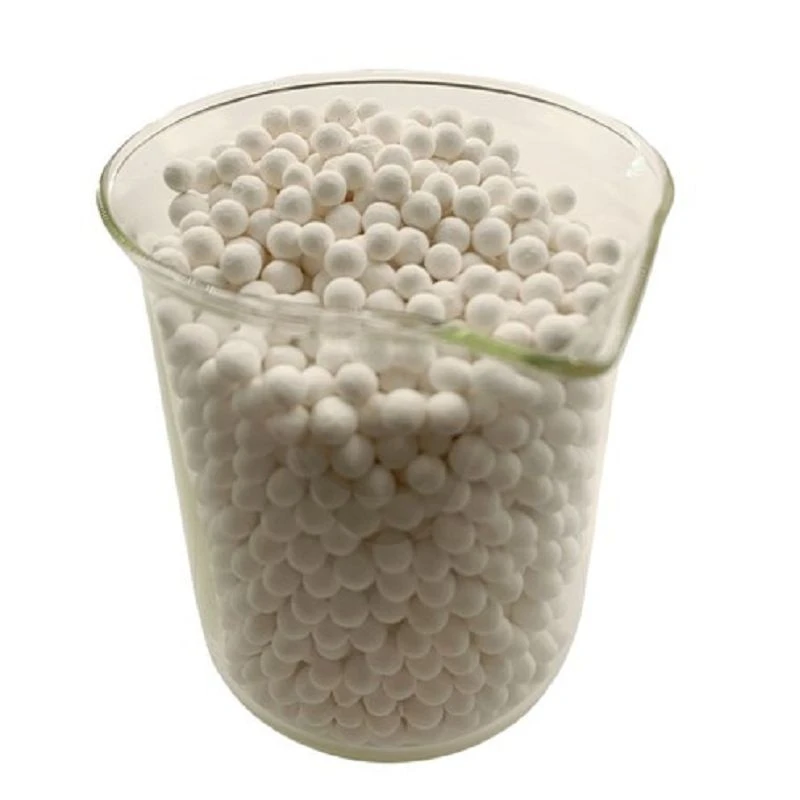
Carbonyl sulfide is notoriously difficult to remove through conventional physical or chemical absorption without prior conversion. Catalytic hydrolysis provides an efficient pathway by reacting COS with process water vapor over an active solid surface.
Diffusion & Adsorption: Process gas diffuses into the porous transition-alumina matrix, where COS molecules adsorb onto active surface sites.
Surface Hydrolysis: Surface hydroxyl species facilitate the hydrolysis reaction, converting COS into H2S and CO2.
Gas Conditioning: The reaction products desorb and flow out with the gas stream, effectively shifting hard-to-treat organic sulfur into easily scrubbed H2S.
Detailed Technical Specification Matrix
|
Technical Parameter |
Specification Range / Standard |
|
Product Name |
Promoted Alumina COS Hydrolysis Catalyst |
|
Primary Chemical Composition |
Transition Alumina (Al2O3) Carrier with Proprietary Alkaline/Metal Promoter |
|
Physical Form |
Extrudates (Cylindrical or Spherical options available upon request) |
|
Available Diameters / Sizes |
1.5 mm to 4.0 mm (Customizable to reactor design) |
|
Bulk Density |
0.65 to 0.85 g/cm3 (Dependent on specific grade formulation) |
|
Specific Surface Area |
Greater than or equal to 180 m2/g (Optimized pore structure for active site dispersion) |
|
Side-Crushing Strength |
Greater than or equal to 120 N/cm (High mechanical durability for deep industrial packed beds) |
|
Attrition Loss |
Less than or equal to 0.5 wt% |
|
Recommended Operating Temperature |
150°C to 380°C (Configured based on process kinetics) |
|
Gas Hourly Space Velocity (GHSV) |
1,000 to 4,000 h-1 (Subject to feed gas composition and target conversion) |
|
COS Conversion Efficiency |
Greater than or equal to 95% (Achievable under defined steady-state operational conditions) |
|
Moisture Tolerance |
Stable in streams with required stoichiometric H2O/COS molar ratios |
|
Packaging Specification |
Steel drums with inner polyethylene liners or heavy-duty FIBC bags |
Typical Industrial Applications
Due to varying gas compositions and operating environments, this catalyst is tailored for diverse industrial gas treatment units:
Syngas Purification: Positioned upstream of acid gas removal systems in coal and biomass gasification plants to eliminate trace sulfur.
Coke Oven Gas Treatment: Applied in coking plants to break down organically bound sulfur compounds prior to fine desulfurization.
Blast Furnace Gas Purification: Deployed in iron and steel off-gas cleaning systems, engineered to handle complex matrices containing trace oxygen and hydrogen chloride.
Industrial Fuel Gas Conditioning: Reduces COS load entering downstream catalytic or combustion equipment where sulfur tolerance is strictly restricted.
Acid Gas Pre-treatment: Acts as a conditioning stage to convert recalcitrant COS before standard sweetening units.
Quality Control & Manufacturing Assurance
To ensure reliable performance in multi-ton industrial packed beds, strict manufacturing and quality controls are implemented:
Raw Material Purity
Rigorous screening of precursor materials and carrier structural integrity.
Promoter Dispersion Control
Precise impregnation and calcination monitoring to guarantee uniform active site distribution.
Physical Testing
Systematic measurement of bulk density, particle size distribution, and high side-crushing strength to prevent dusting and excessive pressure drop.
Traceability
Batch-coded production with complete testing records available for review.
Catalyst Loading & Reactor Installation Guidelines
Proper installation is critical to prevent channeling, excessive pressure drop, and premature mechanical wear in industrial packed beds.
Bed Preparation: Ensure the reactor internals, support grids, and bottom inert support balls are clean and correctly sized to prevent catalyst loss or plugging.
Loading Methods: Dense loading or sock-loading techniques are recommended depending on reactor diameter to ensure uniform void fraction and gas distribution across the bed.
Fines Removal: Screening the catalyst prior to reactor loading removes small particles generated during transit, protecting the system from localized pressure buildup.
Initial Startup Purging: Dry the system thoroughly and purge with inert gas before introducing reactive feed streams to avoid thermal or moisture shock to the promoted alumina matrix.
Packaging, Storage & Shelf-Life Management
Industrial catalysts require specialized handling to preserve catalytic activity and mechanical integrity prior to use.
Standard Packaging: Sealed in moisture-proof steel drums lined with polyethylene liners, or heavy-duty flexible intermediate bulk containers (FIBC) for large-scale projects.
Storage Requirements: Store in a dry, covered warehouse protected from direct weather, high humidity, and chemical vapors. Pallets should be kept off the ground.
Shelf Life: When stored correctly in unopened original containers, the catalyst maintains its chemical and physical specifications for a minimum of 24 months.
FAQ
Q: How does this catalyst handle fluctuating moisture levels in the feed gas?
A: While water vapor is a necessary reactant for COS hydrolysis, extreme moisture fluctuations can alter surface kinetics. The catalyst grade is formulated with a robust transition-alumina matrix to buffer standard process variations, though excessive liquid water condensation must be avoided to prevent pore blocking.
Q: Can this catalyst be regenerated once its activity declines?
A: Depending on the specific deactivation mechanism, such as light sulfur deposition, mild thermal regeneration or in-situ conditioning may restore partial activity. However, if permanent poisoning occurs due to heavy contaminant accumulation, scheduled replacement is typically required.
Q: What is the typical service life expected under normal operating conditions?
A: Operating life depends heavily on feed gas cleanliness, space velocity, and temperature stability. In well-maintained industrial units with stable pre-filtration of heavy contaminants and moisture control, service lifetimes generally range from two to five years.
Q: How do we determine the exact volume required for our reactor?
A: The required catalyst volume is calculated using your volumetric gas flow rate and the specified gas hourly space velocity. Provide your process data, and our engineering team will calculate the exact loading weight based on the bulk density of the recommended grade.
Hot Tags: promoted alumina cos hydrolysis catalyst, China promoted alumina cos hydrolysis catalyst manufacturers, suppliers, factory


