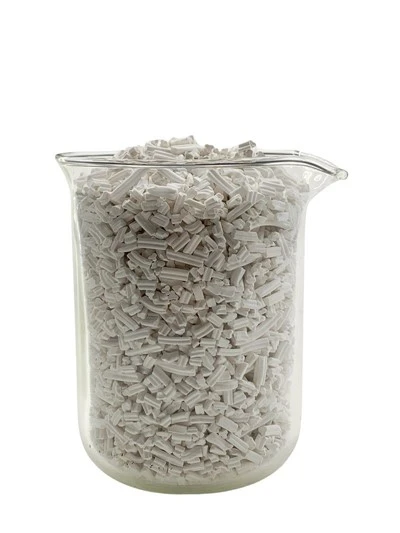
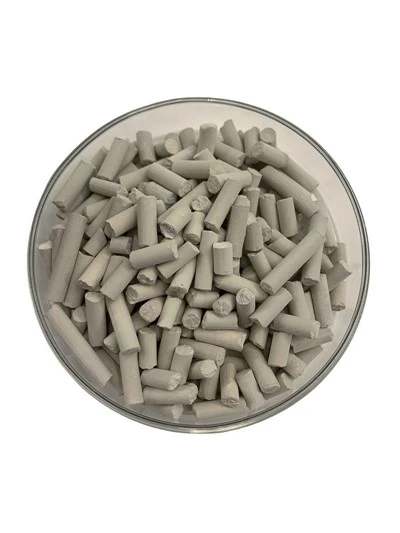
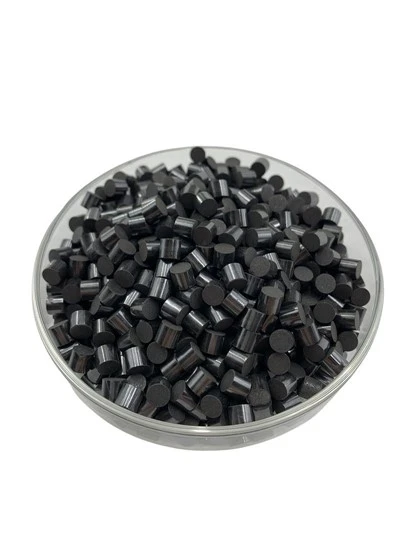
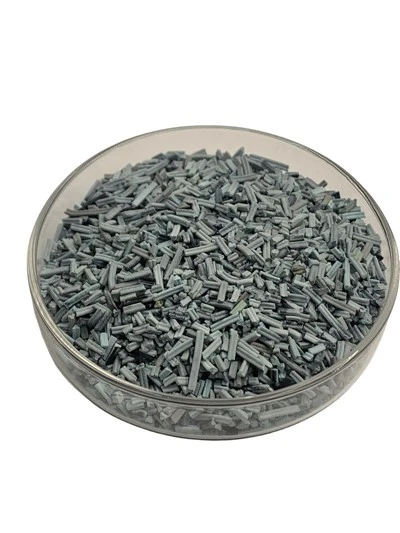
High Activity FCC Pretreatment Catalyst is an engineered hydrorefining catalyst formulated for vacuum gas oil (VGO) treatment upstream of fluid catalytic cracking (FCC) units. The catalyst is designed to reduce sulfur and nitrogen compounds in heavy petroleum fractions, thereby improving the crackability, conversion efficiency, and product selectivity of downstream cracking operations.
Refinery processes handling heavier or more contaminated feedstocks require catalyst systems that balance high intrinsic activity with optimized pore structures to ensure deep removal of contaminants while maintaining long operating cycles.
Catalyst formulations utilize modified alumina and composite support matrices combined with active metal systems such as cobalt-molybdenum (Co-Mo) and nickel-molybdenum (Ni-Mo) active phases. Metal dispersion, pore volume distribution, particle geometry, and mechanical strength can be configured to match specific feedstock compositions and reactor operating windows.
Typical Product Parameters
|
Parameter |
Typical / Available Range |
|
Active Metal System |
Co-Mo, Ni-Mo, Mo-W-Ni |
|
Support Matrix |
Modified alumina / composite support |
|
Specific Surface Area |
150 to 350 m²/g (formulation dependent) |
|
Pore Volume |
0.40 to 0.65 cm³/g |
|
Bulk Density |
0.50 to 0.80 g/cm³ |
|
Catalyst Shape |
Cylindrical extrudates / multi-lobe extrudates |
|
Crushing Strength |
Specified according to particle size and grade |
|
Primary Application |
VGO hydrotreating / FCC feed pretreatment |
|
Standard Packaging |
Steel drums or industrial jumbo bags |
Product Function and Reaction Mechanisms
FCC feed pretreatment operates under high-pressure hydrogen environments to condition the feedstock before it enters the cracking reactor. The primary catalytic functions include:
Hydrodesulfurization (HDS): Cleaves sulfur bonds to control sulfur transfer into the FCC product slate and meet environmental fuel specifications.
Hydrodenitrogenation (HDN): Removes basic and non-basic nitrogen compounds. Because basic nitrogen species can poison or temporarily inhibit the active acidic sites of FCC zeolites, deep HDN is critical for maximizing VGO crackability.
Hydrodemetallization (HDM): Removes trace heavy metals (nickel and vanadium) to prevent the permanent poisoning of cracking catalysts.
Aromatic Saturation: Hydrogenates polycyclic aromatic rings to improve hydrogen-to-carbon ratios and feedstock density profiles.
Regeneration and Long-Term Stability
Catalyst longevity is a primary economic driver in refinery operations.
Activity Retention
Engineered metal-support interactions minimize sintering and active phase loss during extended operation.
Fouling Resistance
Controlled macropore and mesopore distribution accommodates carbonaceous deposits (coke) and trace metal accumulation without premature pore-mouth plugging.
Regeneration Compatibility
Catalyst matrices are structurally stable to support controlled in-situ or ex-situ regeneration cycles where applicable.
Process Integration and Suitable Feedstocks
The pretreatment catalyst is loaded into fixed-bed hydrotreating reactors positioned immediately upstream of the fluid catalytic cracking unit.
Process Flow
[VGO Feed] ➔ [Hydrotreating Reactor (Pretreatment Catalyst)] ➔ [Hydrotreated VGO] ➔ [FCC Unit]
Applicable Feedstock Profiles
Straight-run vacuum gas oil (VGO)
Heavy coker gas oil and thermally cracked fractions
Deasphalted oil (DAO) blends
Heavy feedstocks requiring high-severity HDS, HDN, or contaminant reduction
Manufacturing, Quality Control, and Technical Support
Finished catalyst performance is governed by precision in impregnation, drying, calcination, and structural stabilization.
DCS-Controlled Production: Manufacturing lines utilize distributed control systems to monitor synthesis variables, ensuring batch-to-batch consistency.
Analytical Verification: In-house laboratories verify physical and chemical properties prior to dispatch, including surface area, pore distribution, chemical composition, and mechanical crush strength.
Engineering Support: Technical teams provide support covering catalyst loading advisory, density calculations, and reactor simulation guidance for commercial projects.
Packaging, Handling, and Reactor Loading
Catalysts are delivered in secure, moisture-resistant industrial packaging designed to maintain material integrity during international transit.
Packaging Options: Steel drums with inner protective liners or heavy-duty industrial jumbo bags.
Loading Best Practices: Minimize mechanical impact and dropping during handling. Screen catalyst charges to remove fine particles where specified by loading procedures. Ensure uniform dense-loading or random-loading techniques to prevent localized voidage and excessive reactor pressure drop. Adhere strictly to plant safety guidelines regarding confined space entry and catalyst dust handling.
FAQ
Q: What is the typical turnaround time for a technical evaluation and catalyst recommendation after submitting feedstock data?
A: Initial technical screening and preliminary catalyst grade recommendations are typically provided within 3 to 5 business days following the receipt of complete VGO assay data and operating conditions. Comprehensive kinetic simulation or commercial proposal generation may require additional technical alignment.
Q: Can catalyst formulations be customized for specific refinery revamps or constrained reactor volumes?
A: Yes. Support geometry, pore volume distribution, and active metal ratios can be adjusted to fit existing reactor dimensions, specific pressure drop ceilings, or severe contaminant profiles without requiring hardware modifications.
Q: What precautions are taken to prevent particle breakage and dusting during international ocean freight and handling?
A: Catalysts are packed in heavy-duty steel drums with protective inner liners or moisture-barrier industrial jumbo bags designed to withstand multi-modal transit. Packaging is structurally rated to resist shifting, impact, and moisture ingress, ensuring the material arrives ready for screening and dense-loading.
Hot Tags: high activity fcc pretreatment catalyst, China high activity fcc pretreatment catalyst manufacturers, suppliers, factory, hydrorefining catalyst for advanced biofuels, hydrorefining catalyst for ethylene production, hydrorefining catalyst for hydrocarbon based fuels, hydrorefining catalyst for paint industry, hydrorefining catalyst for pvc production, Petroleum Wax and Vaseline Hydrogenation Catalyst