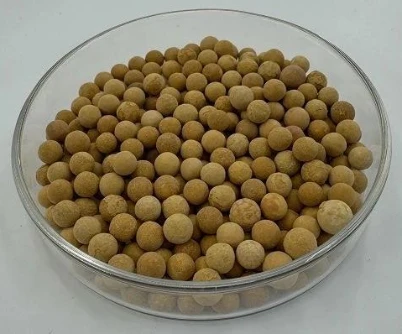
In Claus sulfur recovery units supporting refineries and coal-chemical plants, sulfate-induced deactivation of catalysts is a prevalent long-term operating issue. It acts as a key bottleneck restricting unit service cycle and raising operation-and-maintenance costs.
From a process-principle perspective, trace oxygen inside the unit originates from multiple complex sources: unbalanced air supply for upstream acid gas, flange sealing leakage of equipment, and feed-gas composition fluctuation under intermittent working conditions. These factors allow small amounts of O₂ to enter converters. Oxygen molecules trigger side-reactions with in-situ generated SO₂ to form stable sulfate crystals, which block internal micropores of catalysts and drastically reduce the effective active specific surface area. Consequently, sulfur conversion efficiency keeps declining continuously.
Conventional countermeasures mainly include shortening catalyst replacement cycles and frequent adjustment of air-to-gas ratio parameters. Both solutions have obvious drawbacks. Frequent shutdowns for catalyst replacement interrupt overall plant production and cause heavy economic losses. Delicate air-ratio tuning can only mitigate mild oxygen interference, yet fails to cope with working conditions featuring sharp fluctuations in feed-gas flow rate and H₂S concentration.
Against this industrial backdrop, the layered loading process with oxygen-scavenging protective catalysts has gained growing popularity. It requires no additional reactors or large-scale pipeline retrofits. Only by optimizing the catalyst packing configuration inside the converter can trace oxygen be intercepted at the source to deliver long-term protection for downstream catalyst beds.
The core mechanism lies in staged-reaction protection: catalytic materials with both oxygen-scavenging performance and Claus activity are loaded in the upper section of the converter bed. Process gas flows through this top protective catalyst layer first, where trace oxygen is preferentially consumed and eliminated. Oxygen-free process gas then flows into lower-bed catalysts to carry out stable sulfur-production reactions between H₂S and SO₂.
Uniform industrial practice specifies that the loading volume of the protective catalyst layer shall account for no less than 1/3 of the total bed volume of the converter. Sufficient reaction volume guarantees thorough removal of trace oxygen.
According to industrial operation data, the layered oxygen-scavenging protection loading scheme delivers stable improvement in overall sulfur conversion efficiency of the whole unit, especially suitable for sulfur recovery units with large feed-load fluctuations. Meanwhile, the sulfate poisoning rate of lower-bed catalysts is remarkably slowed down, effectively extending overall catalyst service life and reducing unplanned shutdown frequency.
The oxygen-scavenging protective sulfur-recovery catalysts developed and manufactured by Shandong Xunda Chemical Industrial Group Co., Ltd. have passed long-term performance assessments in multiple commercial units and won positive feedback from customers.