

When loading catalysts into industrial reactors, ceramic balls are essential auxiliary packing materials. Depending on their installation positions and particle sizes, they serve four core functions: supporting bed load, fluid distribution, flow buffering and catalyst protection, which directly impact unit operational stability and catalyst service life.
Large-size ceramic balls laid at the reactor bottom primarily undertake load-bearing support. Catalyst pellets have limited mechanical strength. If stacked directly on the reactor grating support plate, the self-weight of upper catalysts and fluid impact will crush catalyst pellets, generating fine powders that block flow channels. Stacked large-diameter ceramic balls form a support layer with stable voids, evenly transferring the total weight of catalyst beds to the grating to prevent deformation of the support plate. Meanwhile, reserved flow passages stop catalyst particles from leaking out through the bottom discharge port.
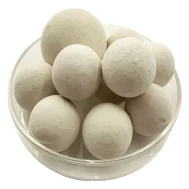
Graded ceramic balls installed in multiple layers achieve uniform fluid distribution. After feed gas or liquid media enter the reactor, channeling and maldistribution frequently occur. Excessively high local flow velocity shortens the contact time between feedstock and catalysts, lowering conversion efficiency. Multi-layer ceramic balls with varying particle sizes form a structure with gradually changing void fractions. As media pass through the ceramic ball layers, fluids are repeatedly split and dispersed to eliminate axial and radial flow velocity differences. Feedstock then flows through the catalyst bed under plug flow conditions, ensuring sufficient reaction contact across all catalyst sections and improving overall conversion rate.
Ceramic balls cushion fluid impact and shield the top catalyst layer. High-speed feed from inlet pipelines directly scours the bed top, easily washing away surface catalysts and triggering local bed collapse and pulverization. A buffer layer of ceramic balls laid on top of the catalyst bed weakens the impact force of incoming fluids and avoids abrasion of catalyst pellets by direct high-velocity scouring. Fluid turbulence caused by pressure and flow fluctuations during startup and shutdown is also absorbed by the ceramic ball layer to maintain integral bed stability.
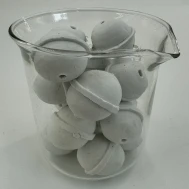
Ceramic balls also deliver thermal homogenization and impurity filtration. Under high-temperature reaction conditions, ceramic balls feature balanced thermal conductivity, mitigating temperature gaps between the bed center and side walls and reducing risks of local overheating and catalyst deactivation. Rust, welding slag and process impurities carried by process media are trapped by ceramic ball layers, preventing hard contaminants from scratching active components of catalysts. This slows bed clogging and pressure drop buildup, extends continuous operation cycles and reduces shutdown cleaning frequency.
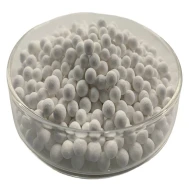
In summary, ceramic balls do not participate in catalytic reactions, yet they create a stable, uniform reaction environment for catalysts. They are critical auxiliary packings that guarantee long-term stable and efficient reactor operation. Selection of ceramic ball sizes and the thickness of each graded layer must be customized according to process flow rate, catalyst particle size and reactor structural design.